For a domain investor, renewal costs can feel like an unavoidable expense of doing business. You buy a domain, hold it, wait for the right buyer, and then pay to keep it every year.
For one domain, the difference between a low-cost renewal and a higher-priced renewal might seem insignificant. But multiply that difference across hundreds or thousands of domains, year after year, and the numbers can become surprisingly large.
The renewal price you pay isn’t just an administrative detail. It directly affects your portfolio’s profitability and return on investment. That’s why understanding renewal markups deserves more attention.
The Difference Between Wholesale and Retail Pricing
When you register a domain, you don’t pay a single universal price set by the Registry. The domain ecosystem generally has several layers, including margins for the Registry and the Registrar.
- The Registry operates the TLD and charges Registrars a wholesale fee.
- The Registrar then sets the price it charges customers. That means two Registrars can charge different prices for the same domain extension.
- For investors with large portfolios, those differences can add up quickly.
This matters most at renewal because you’re not making a one-off purchase; you’re potentially paying the fee every year you keep the domain.
A $2 Markup Doesn’t Sound Much…Right?
Let’s say one registrar charges $10 to renew a domain while another charges $12. That’s only a $2 difference and easy to ignore.
But imagine you have 500 domains; a $2 difference becomes $1,000 per year.
- 1,000 domains = $2,000 per year
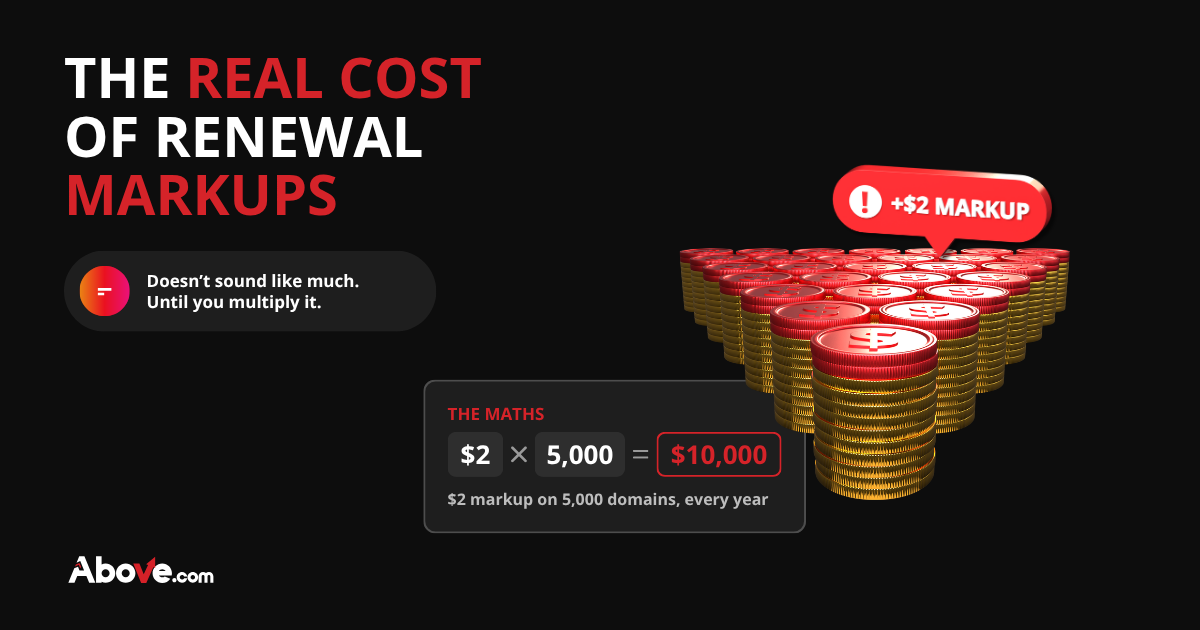
- 5,000 domains = $10,000 per year
- 10,000 domains = $20,000 per year
That is also assuming the difference remains only $2. Some TLDs can have much larger pricing differences between registrars, so small differences add up across a portfolio.
Renewal Costs Compound Over Time
Renewal pricing deserves attention for another reason. You’re not just looking at this year’s cost. You’re looking at the potential cost of holding an asset for several years.
- A portfolio of 2,000 domains with an average renewal cost of $12 adds up to $24,000 per year.
- Over five years, that’s $120,000. Now reduce the average renewal cost by just $2.
- The portfolio would cost $20,000 per year or $100,000 over five years.
That’s a potential $20,000 difference without buying or selling a single additional domain!
Actual savings depend on the TLDs in the portfolio, applicable registry fees, registrar pricing, and whether you can move all domains to the lower-cost provider.
The Markup is Effectively Reducing Your Returns
Domain investors often think about ROI in terms of revenue and sales. But a domain’s return isn’t just the sale price and acquisition price. The ongoing holding costs are real.
If your portfolio contains thousands of domains, those holding costs can become a significant part of your overall economics.
That is why professional investors shouldn’t only calculate how much revenue each domain generates, but also how much it costs to maintain.
The less a domain earns, the more important its renewal cost becomes.
Keep it or Drop it?
As a domain approaches expiry, investors should consider several factors.
- Revenue
- Traffic
- Offers
- Sales history
- Comparable domain sales
- Brandability
- Search demand
- Industry relevance
- Acquisition cost
- Renewal cost
- Potential future value
Above.com’s renewal decision tools bring these factors together, allowing investors to review upcoming expirations alongside revenue, renewal costs, and ROI.
Low Renewal Prices Don’t Always Mean Good Portfolio Management
There’s an important caveat: the cheapest renewal price isn’t automatically the best option. A registrar may offer a low headline price but lack tools that save you time.
Another provider may charge slightly more but offer better automation, reporting, or support. For a domain investor, the right comparison is therefore:
Total portfolio cost = renewal fees + administration + opportunity cost
Above.com focuses on both cost efficiency and portfolio management. As a registrar, we offer the lowest-at-cost pricing on registrations, renewals, and transfers for supported extensions, alongside bulk management and portfolio tools.
Our goal isn’t just to offer cheaper renewals, but to make your whole portfolio cost-efficient. Join us today.
Frequently Asked Questions
What is a domain renewal markup?
A renewal markup is the difference between the underlying wholesale cost of maintaining a domain and the price the registrar charges the customer. Registrars can set different retail prices, so investors with large portfolios should compare renewal costs rather than assuming all registrars charge roughly the same amount.
How much can I save by reducing domain renewal costs?
It depends on your portfolio’s size and TLD mix. Even a $2 reduction in the average renewal cost amounts to $2,000 per year across 1,000 domains, or $10,000 per year across 5,000 domains. The larger the portfolio, the more significant relatively small price differences can become.
How do I know which domains are worth renewing?
Look at more than revenue alone. Consider the domain’s renewal cost, historical revenue, traffic, ROI, sales potential, comparable values and strategic or brandable qualities. A domain generating little revenue might still have significant aftermarket value, while a domain generating some revenue may not justify a high renewal cost.